
Writing with Color: Description Guide – Words for Skin Tone
We discussed the issues describing People of Color by means of food in Part I of this guide, which brought rise to even more questions, mostly along the lines of “So, if food’s not an option, what can I use?” Well, I was just getting to that!
This final portion focuses on describing skin tone, with photo and passage examples provided throughout. I hope to cover everything from the use of straight-forward description to the more creatively-inclined, keeping in mind the questions we’ve received on this topic.
So let’s get to it.
S T A N D A R D D E S C R I P T I O N
B a s i c C o l o r s
Pictured above: Black, Brown, Beige, White, Pink.
“She had brown skin.”
- This is a perfectly fine description that, while not providing the most detail, works well and will never become cliché.
- Describing characters’ skin as simply brown or beige works on its own, though it’s not particularly telling just from the range in brown alone.
C o m p l e x C o l o r s
These are more rarely used words that actually “mean” their color. Some of these have multiple meanings, so you’ll want to look into those to determine what other associations a word might have.
Pictured above: Umber, Sepia, Ochre, Russet, Terra-cotta, Gold, Tawny, Taupe, Khaki, Fawn.
Complex colors work well alone, though often pair well with a basic color in regards to narrowing down shade/tone.
For example: Golden brown, russet brown, tawny beige…
- As some of these are on the “rare” side, sliding in a definition of the word within the sentence itself may help readers who are unfamiliar with the term visualize the color without seeking a dictionary.
“He was tall and slim, his skin a russet, reddish-brown.”
- Comparisons to familiar colors or visuals are also helpful:
“His skin was an ochre color, much like the mellow-brown light that bathed the forest.”
M o d i f i e r s
Modifiers, often adjectives, make partial changes to a word.The following words are descriptors in reference to skin tone.
D a r k – D e e p – R i c h – C o o l
W a r m – M e d i u m – T a n
F a i r – L i g h t – P a l e
Rich Black, Dark brown, Warm beige, Pale pink…
If you’re looking to get more specific than “brown,” modifiers narrow down shade further.
- Keep in mind that these modifiers are not exactly colors.
- As an already brown-skinned person, I get tan from a lot of sun and resultingly become a darker, deeper brown. I turn a pale, more yellow-brown in the winter.
- While best used in combination with a color, I suppose words like “tan” “fair” and “light” do work alone; just note that tan is less likely to be taken for “naturally tan” and much more likely a tanned White person.
- Calling someone “dark” as description on its own is offensive to some and also ambiguous. (See: Describing Skin as Dark)
U n d e r t o n e s
Undertones are the colors beneath the skin, seeing as skin isn’t just one even color but has more subdued tones within the dominating palette.
- Mentioning the undertones within a character’s skin is an even more precise way to denote skin tone.
- As shown, there’s a difference between say, brown skin with warm orange-red undertones (Kelly Rowland) and brown skin with cool, jewel undertones (Rutina Wesley).
“A dazzling smile revealed the bronze glow at her cheeks.”
“He always looked as if he’d ran a mile, a constant tinge of pink under his tawny skin.”
Standard Description Passage
“Farah’s skin, always fawn, had burned and freckled under the summer’s sun. Even at the cusp of autumn, an uneven tan clung to her skin like burrs. So unlike the smooth, red-brown ochre of her mother, which the sun had richened to a blessing.”
-From my story “Where Summer Ends” featured in Strange Little Girls
- Here the state of skin also gives insight on character.
- Note my use of “fawn” in regards to multiple meaning and association. While fawn is a color, it’s also a small, timid deer, which describes this very traumatized character of mine perfectly.
Though I use standard descriptions of skin tone more in my writing, at the same time I’m no stranger to creative descriptions, and do enjoy the occasional artsy detail of a character.
C R E A T I V E D E S C R I P T I O N
Whether compared to night-cast rivers or day’s first light…I actually enjoy seeing Characters of Colors dressed in artful detail.
I’ve read loads of descriptions in my day of white characters and their “smooth rose-tinged ivory skin”, while the PoC, if there, are reduced to something from a candy bowl or a Starbucks drink, so to actually read of PoC described in lavish detail can be somewhat of a treat.
Still, be mindful when you get creative with your character descriptions. Too many frills can become purple-prose–like, so do what feels right for your writing when and where.
Not every character or scene warrants a creative description, either. Especially if they’re not even a secondary character.
Using a combination of color descriptions from standard to creative is probably a better method than straight creative. But again, do what’s good for your tale.
N A T U R AL S E T T I N G S – S K Y
Pictured above: Harvest Moon -Twilight, Fall/Autumn Leaves, Clay, Desert/Sahara, Sunlight – Sunrise – Sunset – Afterglow – Dawn- Day- Daybreak, Field – Prairie – Wheat, Mountain/Cliff, Beach/Sand/Straw/Hay.
- Now before you run off to compare your heroine’s skin to the harvest moon or a cliff side, think about the associations to your words.
- When I think cliff, I think of jagged, perilous, rough. I hear sand and picture grainy, yet smooth. Calm. mellow.
- So consider your character and what you see fit to compare them too.
- Also consider whose perspective you’re describing them from. Someone describing a person they revere or admire may have a more pleasant, loftier description than someone who can’t stand the person.
“Her face was like the fire-gold glow of dawn, lifting my gaze, drawing me in.”
“She had a sandy complexion, smooth and tawny.”
- Even creative descriptions tend to draw help from your standard words.
F L O W E R S
Pictured above: Calla lilies, Western Coneflower, Hazel Fay, Hibiscus, Freesia, Rose
- It was a bit difficult to find flowers to my liking that didn’t have a 20 character name or wasn’t called something like “chocolate silk” so these are the finalists.
- You’ll definitely want to avoid purple-prose here.
- Also be aware of flowers that most might’ve never heard of. Roses are easy, as most know the look and coloring(s) of this plant. But Western coneflowers? Calla lilies? Maybe not so much.
“He entered the cottage in a huff, cheeks a blushing brown like the flowers Nana planted right under my window. Hazel Fay she called them, was it?”
A S S O R T E D P L A N T S & N A T U R E
Pictured above: Cattails, Seashell, Driftwood, Pinecone, Acorn, Amber
- These ones are kinda odd. Perhaps because I’ve never seen these in comparison to skin tone, With the exception of amber.
- At least they’re common enough that most may have an idea what you’re talking about at the mention of “pinecone.“
- I suggest reading out your sentences aloud to get a better feel of how it’ll sounds.
“Auburn hair swept past pointed ears, set around a face like an acorn both in shape and shade.”
- I pictured some tree-dwelling being or person from a fantasy world in this example, which makes the comparison more appropriate.
- I don’t suggest using a comparison just “cuz you can” but actually being thoughtful about what you’re comparing your character to and how it applies to your character and/or setting.
W O O D
Pictured above: Mahogany, Walnut, Chestnut, Golden Oak, Ash
- Wood is definitely an iffy description for skin tone. Not only due to several of them having “foody” terminology within their names, but again, associations.
- Some people would prefer not to compare/be compared to wood at all, so get opinions, try it aloud, and make sure it’s appropriate to the character if you do use it.
“The old warlock’s skin was a deep shade of mahogany, his stare serious and firm as it held mine.”
M E T A L S
Pictured above: Platinum, Copper, Brass, Gold, Bronze
- Copper skin, brass-colored skin, golden skin…
- I’ve even heard variations of these used before by comparison to an object of the same properties/coloring, such as penny for copper.
- These also work well with modifiers.
“The dress of fine white silks popped against the deep bronze of her skin.”
G E M S T O N E S – M I N E R A LS
Pictured above: Onyx, Obsidian, Sard, Topaz, Carnelian, Smoky Quartz, Rutile, Pyrite, Citrine, Gypsum
- These are trickier to use. As with some complex colors, the writer will have to get us to understand what most of these look like.
- If you use these, or any more rare description, consider if it actually “fits” the book or scene.
- Even if you’re able to get us to picture what “rutile” looks like, why are you using this description as opposed to something else? Have that answer for yourself.
“His skin reminded her of the topaz ring her father wore at his finger, a gleaming stone of brown, mellow facades.”
P H Y S I C A L D E S C R I P T I ON
- Physical character description can be more than skin tone.
- Show us hair, eyes, noses, mouth, hands…body posture, body shape, skin texture… though not necessarily all of those nor at once.
- Describing features also helps indicate race, especially if your character has some traits common within the race they are, such as afro hair to a Black character.
- How comprehensive you decide to get is up to you. I wouldn’t overdo it and get specific to every mole and birthmark. Noting defining characteristics is good, though, like slightly spaced front teeth, curls that stay flopping in their face, hands freckled with sunspots…
G E N E R A L T I P S
Indicate Race Early: I suggest indicators of race be made at the earliest convenience within the writing, with more hints threaded throughout here and there.
- Get Creative On Your Own: Obviously, I couldn’t cover every proper color or comparison in which has been “approved” to use for your characters’ skin color, so it’s up to you to use discretion when seeking other ways and shades to describe skin tone.
- Skin Color May Not Be Enough: Describing skin tone isn’t always enough to indicate someone’s ethnicity. As timeless cases with readers equating brown to “dark white” or something, more indicators of race may be needed.
Describe White characters and PoC Alike: You should describe the race and/or skin tone of your white characters just as you do your Characters of Color. If you don’t, you risk implying that White is the default human being and PoC are the “Other”).
- PSA: Don’t use “Colored.” Based on some asks we’ve received using this word, I’d like to say that unless you or your character is a racist grandmama from the 1960s, do not call People of Color “colored” please.
- Not Sure Where to Start? You really can’t go wrong using basic colors for your skin descriptions. It’s actually what many people prefer and works best for most writing. Personally, I tend to describe my characters using a combo of basic colors + modifiers, with mentions of undertones at times. I do like to veer into more creative descriptions on occasion.
- Want some alternatives to “skin” or “skin color”? Try: Appearance, blend, blush, cast, coloring, complexion, flush, glow, hue, overtone, palette, pigmentation, rinse, shade, sheen, spectrum, tinge, tint, tone, undertone, value, wash.
Skin Tone Resources
- List of Color Names
- The Color Thesaurus
- Things that are Brown (blog)
- Skin Undertone & Color Matching
- Tips and Words on Describing Skin
- Photos: Undertones Described (Modifiers included)
- Online Thesaurus (try colors, such as “red” & “brown”)
- Don’t Call me Pastries: Creative Skin Tones w/ pics 3 2 1
Writing & Description Guides
- WWC Guide: Words to Describe Hair
- Writing with Color: Description & Skin Color Tags
- Describing Characters of Color (Passage Examples)
- 7 Offensive Mistakes Well-intentioned Writers Make
I tried to be as comprehensive as possible with this guide, but if you have a question regarding describing skin color that hasn’t been answered within part I or II of this guide, or have more questions after reading this post, feel free to ask!
~ Mod Colette
THIS NEVER CEASES TO BE AMAZING, bless writingwithcolor
oh thank fuck you have no idea how long ive been slamming my head against a wall like “HOW DO I DESCRIBE JOSIE’S SKIN???? HOW?????”






🐦
Banter is a young elf princess of the Aoife Woods. She likes to collect dead animals, especially moths and butterflies and birds because she has a special affinity for wings. Their wings. Wings of the dead. Her solving of rubic’s cubes is falsely founded, as her research into the world wide web of spiders has given her insight to complex puzzles and twisters.
—-▸Once again brought to you by our amazingly weird stream convos and @cachinnus ✌
What came to be from yesterday’s instructive character design stream! Thanks everyone for coming, I’ll get better at doing walkthroughs, I promise! ;P
And if you missed out, I’m doing weekly streams every Saturday now! The subject matter will change each every week but will all be related to characters or illustration in one way or another 🙂
For weekly streaming or to view the recorded process of this video check out my Twitch!
Or for frequent streaming updates check out my Twitter! I hold polls sometimes to vote on what will be in next weeks stream!









Posted by Steven Payne to Facebook group British Medieval History:
People in the Middle Ages valued sweet smelling breath and bodies, seeing them as desirable, so there is a great deal of evidence from the period of tooth pastes, powders and deodorants.
Contrary to the typical Hollywood depiction of medieval peasants with blackened and rotting teeth, the average person had teeth which were in fairly good condition, mainly due to the rarity of sugar in the diet. Most medieval people could not afford sugar and those who could used it sparingly.
Archaeological data shows that only 20% of teeth had signs of decay, as opposed to 90% in the early twentieth century. The main dental problem for medieval people was not decay but wear, due to a high content of grit in the main staple, bread.
For deodorants, soap was available for the wealthy, but a variety of herbs and other preparations were also used. Soapwort is a plant native to Europe and Asia which, when soaked in water, produces an effective liquid soap. Mint, cloves and thyme were also extensively used by simply rubbing into the skin, and alum (hydrated potassium aluminium sulphate) was an effective deodorant.
I am trying to keep to 14th century technology on my pilgrimage to Canterbury, which gives me various options when looking at hygiene. In the middle ages people generally cleaned their teeth by rubbing them and their gums with a rough linen cloth, or the chewed end of a stick. There are various recipes for pastes and powders that could be put on the cloth to help clean the teeth, but I have chosen simple salt to whiten them and to aid fresh breath. I will also be using the stick method, and will be taking along a supply of liquorice root sticks for that purpose.
I also have a few blocks of alum, which when rubbed into wet skin has a deodorising effect. Alum, like beeswax, was used extensively in the middle ages for a variety of purposes, also being useful:
* in the purification of drinking water as a flocculant
* as a styptic to stop bleeding from minor cuts
* as a pickling agent to help keep pickles crisp
* as a flame retardant
* as an ingredient in modelling clay
* as an ingredient in cosmetics and skin whiteners
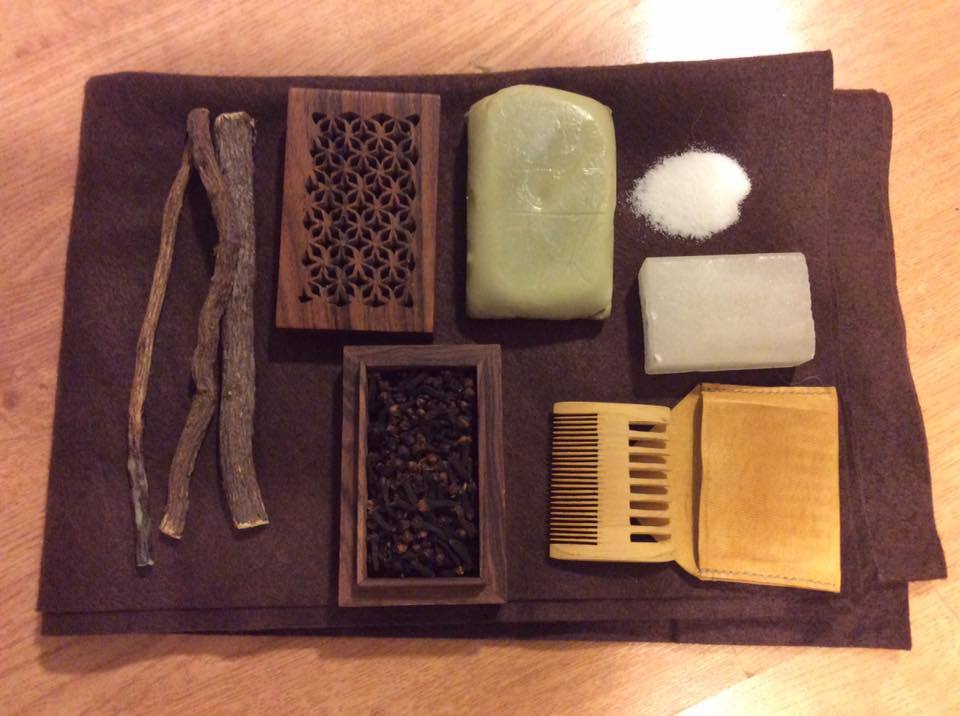
* as an ingredient in some brands of toothpasteThe photograph shows my wash kit including home made olive oil soap, salt for the teeth, a block of deodorising alum, cloves, a boxwood comb made for me by Peter Crossman of Crossman Crafts and some liquorice root sticks, all on a woollen ‘towel’.
Note that the cloves are kept in a ventilated box….this is because insects hate the smell of cloves and so a perforated box will keep them out of my kit and food bag when I am sleeping rough.
TIP: If you steep some cloves to obtain the oil and put the liquid around the doors and windows of your house, it keeps spiders and insects out.Pay attention medieval-ish fantasy authors- filthy people without any cleaning or self care is Not Historical.


 skysonglark reference