Long story short: what do you want to put into it?
It is your book, to do with as you will. Put in whatever you think you will want / need to know, that reflects your style of practicing, etc.
In a tl;dr version of all those links, and a modified version of [this post], here’s some ideas on things you can put into a grimoire (based mostly around informational purposes).
This list is not complete / extensive / ;moreso, it has a lot of different suggestions to give you some ideas of things you can put in.
about you as a witch
these could be in the format of journal pages
what you want out of witchcraft, information about your natal / birth chart if you like astrology, any notes of things you do day to day, etc.
terminology of terms within witchcraft and magic
spell timing, such as Sabbats and esbats, moon phases, days of the week, time of the day, etc.
correspondences for herbs, essential oils, crystals / minerals, colors, the four elements, planetary associations, etc.
substitutions for particular items like herbs, crystals, etc.
any safety precautions for working with certain herbs, crystals, etc.
information on how to determine personal correspondences and associations
magical / non-magical materials that can be used in spells
information on the “basics” of witchcraft
what intent means, and how to work with it
what it means to visualize, and alternatives if you can’t
what meditation can do for magic, and how to do it
what channeling energy means, and how to do it
what it means to charge / enchant objects, and methods to do it
setting up an altar / magical work space, and how to do it
information on any religions you work within
example: for Wicca, you may wish to write out the Wiccan Rede, how to cast a circle, how to call the four corners / elements / guardians of the watchtowers, how to set up an altar, etc.
information on any deities you work with / wish to work with
offering ideas for any deities you work with
invocations for any deities you work with
rituals / dedications / prayers to any deities you work with
information on any spirits you work with / wish to work with
offering ideas for any spirits you work with (i.e. the fae, elemental spirits like sylphs and salamanders, etc.)
information on the history of witchcraft
information on familiars and working with animals in magic
information on varieties of magic
examples: energy work, candle magic, crystal magic / crystal grids, sachet magic, knot magic, kitchen magic / tea magic, bath magic, traditional magic, urban / modern magic, chaos magic, pop culture magic, green magic, hedgework, spirit work, shadow work, blood magic, sex magic, necromancy / death magic, etc.
MAGIC NO LONGER LOOKS LIKE A WORD TO ME
any safety precautions for working with certain varieties of magic
any divination methods you wish to try
examples: definitions of the tarot cards, tarot spreads, cartomancy interpretations, definitions of runes, reading tea leaves (tasseomancy) / coffee grounds, tips on pendulum reading, etc.
spells that you write yourself, or sigils you create yourself
any notes and observations you made when testing that spell / using it
spells or sigils from external sources that you may want to use and/or reference
Middle Ages (or Medieval period), lasted from the 5th to the 15th century. It began with the collapse of the Western Roman Empire and merged into the Renaissance and the Age of Discovery. The Middle Ages is the middle period of the three traditional divisions of Western history: Antiquity, Medieval period, and Modern period. The Medieval period is itself subdivided into the Early, the High, and the Late Middle Ages. [1] [2]
From Washington, D.C., the rings would only fill a portion of the sky, but appear striking nonetheless. Here, we see them at sunrise.
From Guatemala, only 14 degrees above the equator, the rings would begin to stretch across the horizon. Their reflected light would make the moon much brighter.
From Earth’s equator, Saturn’s rings would be viewed edge-on, appearing as a thin, bright line bisecting the sky.
At the March and September equinoxes, the Sun would be positioned directly over the rings, casting a dramatic shadow at the equator.
At midnight at the Tropic of Capricorn, which sits at 23 degrees south latitude, the Earth casts a shadow over the middle of the rings, while the outer portions remain lit.
Also idk if y’all are dweebs about local legends and obscure historical facts and monuments and cool things in your city that are like…..unconventional I guess
But there’s this website called AtlasObscura.com where you can literally put in ur zip code or ur city or ur state and it’ll literally show you a map and list of a bunch big super cool interesting sometimes spooky things in ur area!!!
Like if you’re into crypts and catacombs and history and legends and unusual attractions….this is ur best bet
Especially if you’re visiting a city (like Boston cough) where you want to not solely do the popular overpriced and over packed typical tourist shit this summer!!!
THOU is the subject (Thou art…) THEE is the object (I look at thee) THY is for words beginning in a consonant (Thy dog) THINE is for words beginning in a vowel (Thine eyes)
this has been a psa
Also, because H was sometimes treated as a vowel when the grammar rules for thou/thee/thy/thine were formed,THINE can also be used for words beginning with H. For example, both “thy heart” and “thine heart” appear in Elizabethan poetry.
For consistency, however, if you’re saying “thine eyes”, make sure you also say “mine eyes” instead of “my eyes”.
Further to the PSA:
Thou/thee/thine is SINGULAR ONLY.
Verbs with “thou” end in -st or -est: thou canst, thou hast, thou dost, thou goest. Exception: the verbs will, shall, are, and were, which add only -t: thou wilt, thou shalt, thou art, thou wert.
Only in the indicative, though – when saying how things are (“Thou hast a big nose”). Not in the subjunctive, saying how things might be (“If thou go there…”) nor in the imperative, making instructions or requests (“Go thou there”).
The -eth or -th ending on verbs is EXACTLY EQUIVALENT TO THE -(e)s ENDING IN MODERN ENGLISH.
I go, thou goest, she goeth, we go, ye go, they go.
If you wouldn’t say “goes” in modern English, don’t say “goeth” in Shakespearean English.
“Goeth and getteth me a coffee” NO. KILL IT WITH FIRE.
Usually with an imperative you put the pronoun immediately after the verb, at least once in the sentence (“Go thou” / “Go ye”).
YE is the subject (Ye are…). YOU is the object.
Ye/you/your is both for PLURALS and for DEFERENCE, as vous in French.
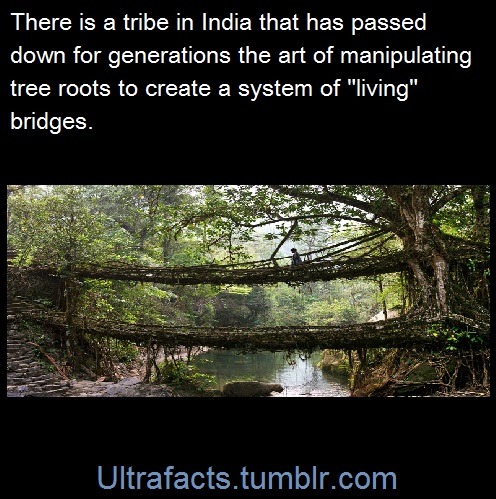
They are not some anonymous “a tribe in India”, they are the War-Khasi. Speaking as a former anthro student and as a reference librarian, I am beyond sick of posts (and articles, and emails, and museum displays) like this that present the work of a people without actually naming the people. It’s erasure, it’s reducing the great works of a culture to an Ozymandias-esque curiosity for foreigners to consume rather than an accomplishment that should help bring awareness of that culture’s existence.
They are the War-Khasi, a division of the Khasi, a people who call themselves Hynñiew Trep. They live in Meghalaya, and they have been building these bridges in the town of Cherrapunji for longer than anyone knows. They are not anonymous.
This is Natalya Kopylova, the head of the Samara club of Slavic cultures “Vesta”. What she is doing is usually called “фланкировка” in Russian, which, I think, would be translated as flourish or twirling here. It’s a traditional Cossack entertainment, demonstration of dexterity and ability to handle weapon. In the comments to the video on YouTube it was pointed that Natalya wears traditional Orenburg Cossack dress and twirls traditional Cossack weapons shashkas (шашки).






 skysonglark reference